
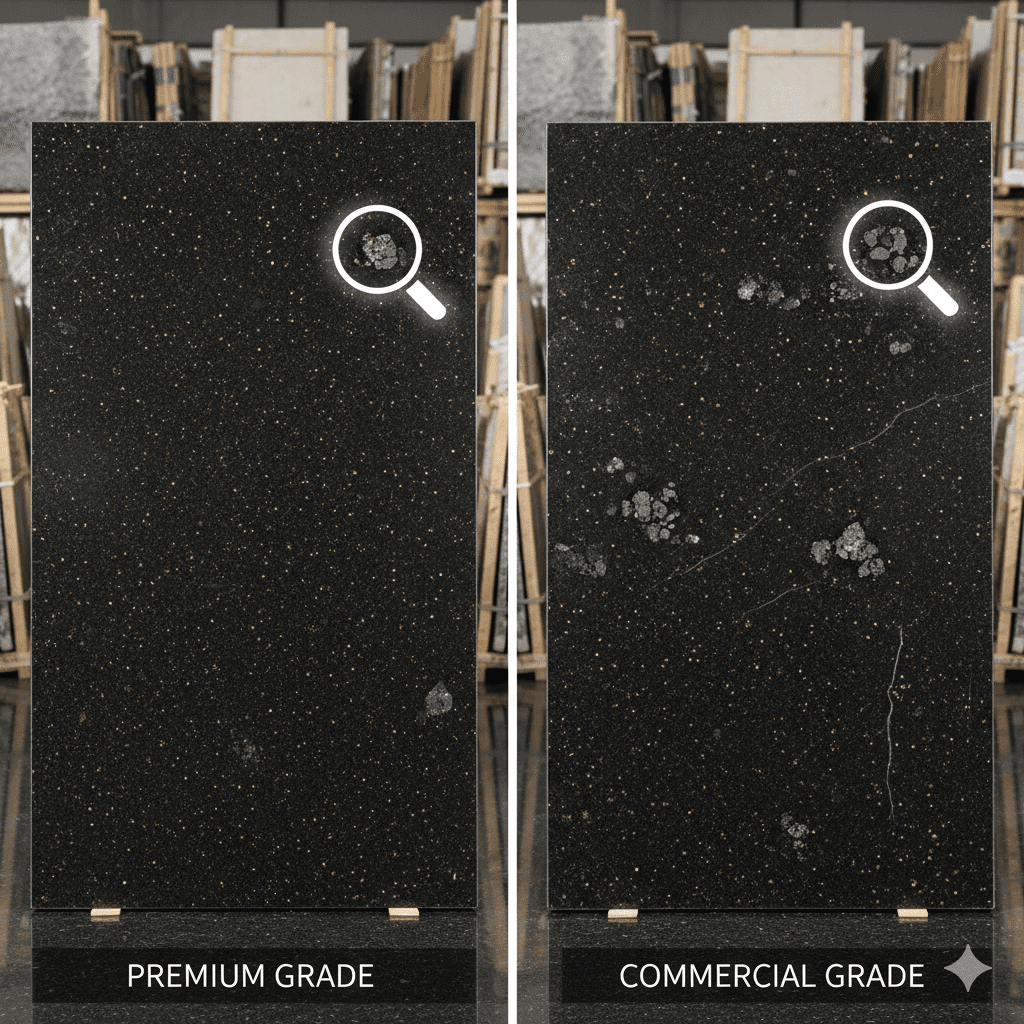
When sourcing natural stone from India, understanding the nuances of quality grading is essential for ensuring the longevity and aesthetic appeal of your project. Specifically, the distinction between premium and commercial grade granite often dictates the final outcome of high-end architectural designs. While both grades originate from the same quarries, their physical characteristics and structural integrity vary significantly. Therefore, procurement managers and architects must accurately identify these differences to mitigate risks and ensure they receive the value they expect.
Quick Answer: Premium vs. Commercial Grade Granite
What is the difference between premium and commercial grade granite? Premium grade granite features superior structural density, minimal natural pits, and highly consistent color patterns with virtually no visible defects. In contrast, commercial grade granite may contain more frequent mineral streaks, natural fissures, or significant color variations. Consequently, premium stone is reserved for high-visibility luxury projects, while commercial grade is often utilized for large-scale developments where budget takes precedence over absolute uniformity.
Visual and Structural Characteristics
The most immediate difference lies in the visual “cleanness” of the slab. Premium grade granite is meticulously selected for its uniform background and lack of “black spots” or uneven mineral clusters. Moreover, premium slabs undergo a more rigorous polishing process, resulting in a mirror-like finish that is difficult to achieve with lower-tier stones. On the structural side, premium granite is less porous and boasts higher compressive strength. This makes it more resistant to staining and cracking over time, which is particularly vital for outdoor cladding or heavy-traffic flooring.
Impact on Project Scalability and Cost
While commercial grade granite offers significant cost savings, it often requires more maintenance and careful installation to hide natural imperfections. For instance, a developer working on a large-scale residential project might choose commercial grade to stay within budget, accepting that some slabs will have unique “character” marks. However, for a luxury hotel lobby, only premium grade will suffice to maintain a seamless, high-end look across thousands of square feet. Notably, choosing the right grade from the start prevents costly replacements and ensures that the stone evolves gracefully with the building.
Reader Impact: Making the Right Choice
Ultimately, your choice between premium and commercial grade should align with your specific project goals and the expectations of your end-user. By opting for premium Indian granite, you invest in a material that offers unmatched reliability and a timeless aesthetic. Conversely, commercial grade remains a viable, cost-effective solution for less prominent areas. To ensure you receive exactly what you ordered, always request high-resolution photos or a live video inspection of the specific blocks being processed for your order.
Summary of Differences
- Aesthetics: Premium is highly uniform; Commercial has natural variations.
- Durability: Premium has higher density and fewer fissures.
- Application: Premium is for luxury/high-traffic; Commercial is for budget-conscious large projects.
Our Consolidation & Packaging Process
To ensure that the distinction between premium and commercial grades is maintained until the stone reaches your doorstep, we implement a rigorous packaging protocol. First, every slab is separated by protective foam layers to prevent surface scratching. Subsequently, we secure these materials into ISPM-15 certified wooden crates. This international standard for phytosanitary measures is mandatory for all wood packaging used in international trade. By using ISPM-15 certified materials, we guarantee that the crates have been heat-treated to prevent the spread of pests. Consequently, this prevents costly customs delays or shipment rejections at your destination port. Whether you are importing a single pallet of premium marble or a full container of commercial granite, these standards remain non-negotiable for a professional Indian exporter.